Best Pool Shapes for Family Backyards
AdminA pool can look brilliant on paper and still be wrong for the way your family actually lives. The best pool shapes for family backyards are not always the most dramatic or the most expensive. They are the ones that suit your block, give kids room to play, leave space for entertaining, and work with the rest of your outdoor area instead of taking it over.
For Brisbane and South East Queensland homeowners, that usually means thinking beyond the pool shell alone. The right shape has to fit the house, the yard, the slope of the block, the fencing requirements, the paving zones, and how you want to use the space on a normal Saturday afternoon. A family pool needs to be practical first, then beautiful. The good news is those two things can absolutely go together.
How to choose the best pool shapes for family backyards
The shape that works best depends on a few key factors. The first is how your family will use the pool. If the main goal is relaxed swimming, step access and room for younger children to splash, you will likely make different choices than a household focused on exercise, entertaining, or older kids who want open water for games.
The second factor is your block. A wide, flat backyard gives you more flexibility. Narrow sites, sloping blocks, and homes with existing retaining walls or tight access can push the design in a more specific direction. This is where custom design matters. What looks like a simple shape decision often affects excavation, drainage, landscaping, fencing and the overall cost of the project.
Then there is the question of balance. A pool should improve the backyard, not consume it. Families still need room for outdoor dining, lawn, garden zones and circulation around the pool. In many cases, the best result is not the largest pool possible. It is the one with the smartest footprint.
Rectangular pools - the most reliable all-rounder
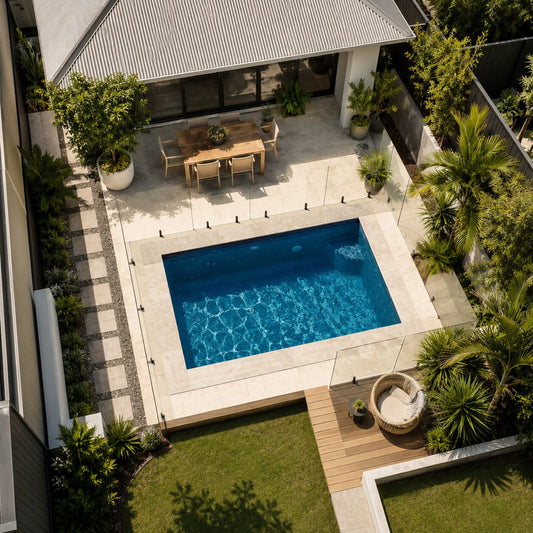
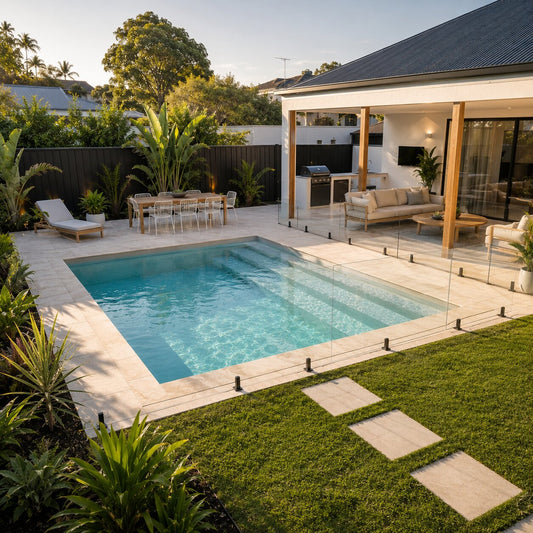
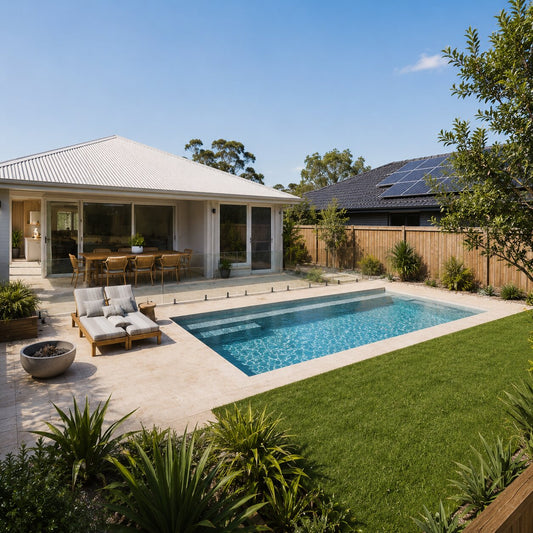
For many homes, a rectangular pool is the strongest choice. It is clean, practical and easy to integrate into modern outdoor spaces. It also makes very efficient use of space, which is one of the biggest reasons it suits family backyards so well.
A rectangle gives you a long, usable swim zone and clear edges for supervision. Parents can easily see from one end to the other, which helps when children are in the water. It also leaves room to include wide entry steps, a shallow ledge, or bench seating without making the pool feel awkward.
From a planning perspective, rectangular pools tend to work well with paving, fencing and adjacent entertaining areas. They sit neatly beside alfresco spaces and often align better with the house. If you are building a complete backyard rather than just dropping a pool into spare space, this shape usually makes the overall layout easier to organise.
The trade-off is that a rectangle can feel formal if the surrounding landscaping is too rigid. That is usually solved through materials and layout. Softer planting, varied paving textures and thoughtful lighting can make a rectangular pool feel warm and family-friendly rather than severe.
Best for
Rectangular pools are ideal for families who want versatility, straightforward supervision and a shape that adds long-term value without dating quickly.
L-shaped pools - great for mixed-use backyards
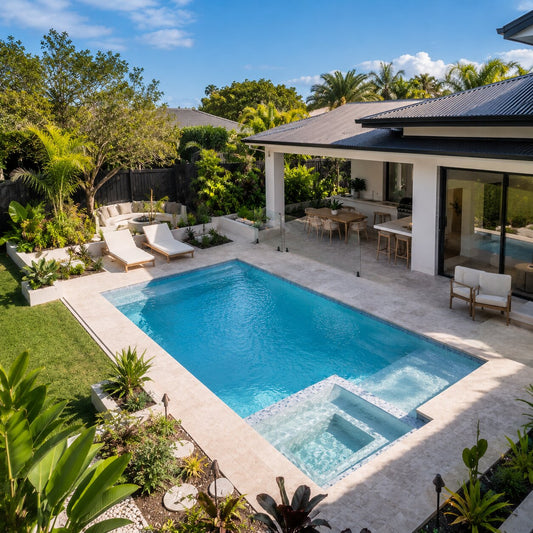
If your family wants separate zones for different activities, an L-shaped pool deserves serious consideration. This design can create a dedicated shallow area for children or lounging while preserving a longer section for swimming.
That split in the layout is what makes it so useful. One leg of the pool can support play and casual use, while the other remains open for laps or older kids. It can also help define different parts of the backyard, especially when paired with a patio, pavilion or outdoor kitchen.
L-shaped pools are especially effective in backyards where you want the pool to wrap around an entertaining space or respond to the shape of the house. On some sites, they can feel more natural than forcing a single straight form into a layout that does not suit it.
The downside is efficiency. Compared with a rectangle, an L-shape may require more surface area and can complicate some landscaping and paving details. It needs to be designed carefully so the corners feel intentional rather than leftover.
Freeform pools - softer look, less efficient footprint
Freeform pools have curved lines and a more relaxed appearance. They often appeal to homeowners who want a resort-style feel or a backyard with softer, more organic landscaping.
For some family homes, this shape works well because it feels less formal and can blend nicely with gardens, tropical planting and irregular yard lines. Curves can also soften the visual impact of the pool, which is helpful if you want the space to feel more like a retreat than a statement piece.
That said, freeform pools are not always the best use of space in suburban backyards. Curved edges can reduce the amount of straightforward swim area and make it harder to position furniture, paving and fencing efficiently. You can also end up with odd leftover spaces around the pool perimeter.
For families with younger children, supervision is another factor. Curves and hidden corners are not necessarily unsafe, but straight sightlines are often easier to manage. If you love the softer look, it is worth balancing that preference against the practical day-to-day use of the pool.
Lap-style pools - ideal for narrow Brisbane blocks
On tighter sites, a lap-style pool can be one of the best pool shapes for family backyards, particularly in Brisbane suburbs where side setbacks and narrow outdoor areas can limit options. These pools are long and slim, making them excellent for compact or elongated blocks.
A lap-style design can still be family-friendly if it includes generous entry steps, a shallow end or a sitting ledge. It does not have to be purely for exercise. In fact, many families choose this shape because it preserves more surrounding yard space while still delivering a high-end result.
This is often a smart option when you want a pool and an outdoor living zone without sacrificing every bit of lawn. It can run neatly alongside a house, boundary or entertaining area and create a strong architectural look.
The limitation is width. If your household wants plenty of room for pool games, inflatables and groups of kids splashing around at once, a narrow lap pool may feel restrictive. It suits some family lifestyles very well, but not all.
Plunge pools - better for smaller households than active families
Plunge pools have become popular for compact backyards, and they can look fantastic. They are excellent for cooling off, relaxing and adding value to a smaller property. But for larger families or households with energetic children, they are not always the strongest long-term choice.
A plunge pool works best when the brief is more about lifestyle and visual appeal than active recreation. If your children are very young, it may meet your needs for now. If they are likely to want more room to swim and play over the next few years, you may outgrow it quickly.
That does not mean a plunge pool is the wrong call. It simply means expectations need to be realistic. The shape and scale should match how the pool will actually be used, not just how it will look in photos.
What often matters more than shape
Homeowners sometimes focus so heavily on shape that they miss the features that make the biggest difference to family use. Entry design is one of them. Wide steps, shallow shelves and easy access points can dramatically improve safety and comfort.
Depth profile matters too. A family pool usually benefits from a sensible shallow section rather than a design that becomes deep too quickly. Seating ledges, coping width, non-slip surfaces and surrounding drainage are just as important as the outline of the pool itself.
Then there is the broader backyard plan. The best pool shape can still fail if the paving is cramped, the fencing feels awkward, or there is no shaded space nearby for supervision and entertaining. This is why many homeowners prefer a single team to handle pool construction and landscaping together. It leads to a better result and a far less stressful build.
Choosing the right shape for your block and family
If your yard is generous and you want the safest all-round option, a rectangular pool is usually the front-runner. If you want distinct activity zones, an L-shape may give you more flexibility. If your home leans toward a softer landscape style, a freeform design can work beautifully if the space allows for it. And if your block is narrow or sloping, a custom lap-style solution may be the most practical path.
For many Brisbane homeowners, the right answer sits somewhere between lifestyle goals and site realities. That is where experienced design advice becomes valuable. A good builder will not push a fashionable shape that fights the block. They will help you choose one that performs well, looks right and supports the way your family wants to live outdoors.
A well-designed family pool should feel easy from the moment you step outside. If the shape supports that, you are on the right track.