Spa Pool Combo vs Separate Spa: Cost, Heating and Fencing in Brisbane
Wahoo Pool & Landscape ConstructionIf you are building a new concrete pool and want a spa as well, a spa built into the pool is usually the cheaper and more space-efficient way to get one. A separate spa earns its extra cost when you want it somewhere else in the yard, want to run it completely independently of the pool, or the block's levels make a single structure awkward. On our fixed-price packages, adding a 2 m × 2 m integrated spa adds $12,390 on every size it is offered (as listed in October 2026), taking a pool and spa combo from $58,790 to $76,690. The heater is quoted separately, and that is where most of the real decision sits.
Below are the actual figures, what the spa upgrade does and does not include, why heating is the part to look at hardest, and the Queensland barrier rule that catches people out with a stand-alone spa.
Spa pool combo vs separate spa - what is the difference?
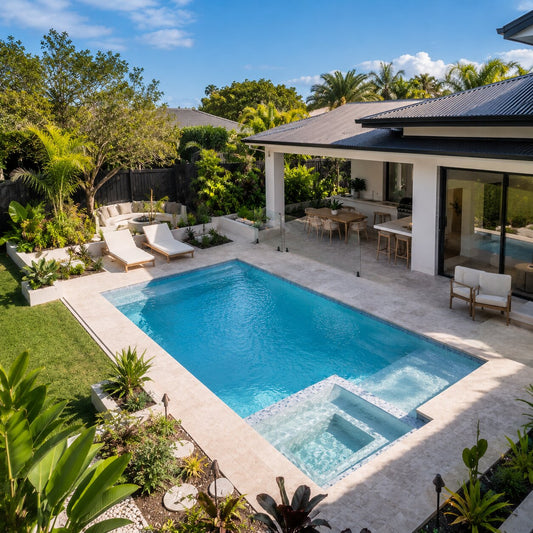
A spa pool combo is a spa built into or directly attached to the pool shell. It usually sits flush with the pool or slightly raised, shares the pool's finishes, and reads as one feature. In most designs it also shares the pool's filtration and water.
A separate spa is its own vessel. It might sit beside the pool, next to the alfresco, under a pavilion or at the other end of the garden. It can be finished to match the pool, but structurally and mechanically it is a second installation with its own water to treat and heat.
What a pool and spa combo costs on our packages
These are the published package prices read from our catalogue on 7 October 2026. They are "from" prices for the pool and spa as packaged; your itemised quote adds the site-specific items listed further down. Check the package page for the current figure before you budget.
| Package | Water size | Pool only | Pool + 2 × 2 m spa | Water (pool / with spa) |
|---|---|---|---|---|
| Family Pool I | 6 × 4 m | $46,400 | $58,790 | 36,000 L / 42,000 L |
| Family Pool II | 7 × 3 m | $46,400 | $58,790 | 31,500 L / 37,500 L |
| Resort Pool I | 7 × 4 m | $50,400 | $62,790 | 42,000 L / 48,000 L |
| Resort Pool II | 8 × 3 m | $50,400 | $62,790 | 36,000 L / 42,000 L |
| Entertaining Pool I | 8 × 4 m | $55,200 | $67,590 | 48,000 L / 54,000 L |
| Entertaining Pool II | 9 × 3 m | $55,200 | $67,590 | 40,500 L / 46,500 L |
| Contemporary Pool I | 9 × 4 m | $59,200 | $71,590 | 54,000 L / 60,000 L |
| Contemporary Pool II | 10 × 3 m | $59,200 | $71,590 | 45,000 L / 51,000 L |
| Grand Pool | 10 × 4 m | $64,300 | $76,690 | 60,000 L / 66,000 L |
Two things worth noticing. The spa costs the same $12,390 whichever pool it is attached to, so as a share of the total it matters most on the smaller sizes. And the integrated spa is only offered from the 6 m × 4 m and 7 m × 3 m packages upwards. The three smallest sizes (5 × 3, 5 × 4 and 6 × 3) do not have a spa option. If your yard only fits a plunge or courtyard pool, a heated plunge pool can do much of what a spa would.
What the $12,390 covers, and what it does not
The spa upgrade on our packages includes the integrated spa shell, dedicated spa jets and the plumbing that ties the spa into the pool's filtration. Everything else in the package is the same with or without the spa. On the 6 m × 4 m Family Pool I, for example, that is the 200 mm reinforced concrete shell, pebble interior, coping, Zodiac/Waterco filtration, LED pool light, and the engineering and compliance documentation.
Not included, in either version:
- Spa heating. A heat pump or gas heater is quoted separately. Without one, the spa sits at the same temperature as the pool.
- Site preparation and excavation.
- Pool fencing and the pool safety certificate.
- Paving, decking and surrounding landscaping.
- Electrical mains connection and commissioning.
Those exclusions apply to any pool, but they matter more with a spa because the heater and its electrical or gas supply are a meaningful part of the spend. When you compare quotes, check whether the other builder's "pool and spa" price includes a heater. If it does not say, assume it does not. Our breakdown of real Brisbane pool costs covers the site items in more detail.
Heating: the question that decides running costs
Water takes a fixed amount of energy to warm up: about 1.16 watt-hours per litre for every degree. That makes the size of the body of water you are heating the single biggest factor in what a spa costs to use. The package specifications put the integrated spa at roughly 6,000 litres. Here is what that means for a 10 °C lift, before any heat lost to the air, which in practice adds to every figure:
| What you are heating | Water | Heat needed for a 10 °C lift | Time at 15 kW of heat output |
|---|---|---|---|
| The spa on its own | ~6,000 L | ~70 kWh | ~4.7 hours |
| 6 × 4 m pool and spa together | ~42,000 L | ~488 kWh | ~33 hours |
| 10 × 4 m pool and spa together | ~66,000 L | ~767 kWh | ~51 hours |
The figures are rounded and illustrative; they are physics, not a quote, and a real heater's output depends on the unit and the weather. The point is the ratio: warming the pool and spa together takes seven to eleven times the energy of warming the spa alone.
So the practical question for a combo is whether the spa can be run on its own circuit when you heat it. Most integrated spas are plumbed with valves so the pump can circulate just the spa water through the heater while the pool stays at its own temperature. If the spa spills over into the pool while you are heating it, warm water keeps flowing out into the larger body of water. Ask to see on the plan how the spa will be isolated, how the spillover is switched off, and what size heater is proposed.
A separate spa is isolated by design. That is its main running-cost advantage, but it comes with its own pump, filter, sanitiser and heater, or with extra plumbing back to a shared equipment area. You are paying for that independence up front. For a comparison of heat pump, gas and solar running costs, see our guide to pool heating in Brisbane.
A separate spa is a pool in the eyes of Queensland law
This rule can change a "spa by the back door" plan. Under Queensland's pool safety laws, a spa that can hold 300 mm or more of water is treated as a swimming pool. It needs a building approval, has to be registered with the QBCC, and must sit behind a compliant barrier. A lockable lid or cover does not remove that requirement; the QBCC's pool safety guide and the City of Gold Coast both say so plainly.
What that means in practice:
- An integrated spa sits inside the pool's barrier, so it is covered by the same fence.
- A separate spa either has to sit inside the existing certified pool barrier, or it needs a compliant barrier of its own. That means at least 1200 mm high, a self-closing and self-latching gate, and a 900 mm non-climbable zone outside it.
- A spa placed hard against the house brings the building itself into the barrier question, because the pool safety standard also deals with access from a building into the pool area. That is something to resolve with your certifier at design stage, not after the spa is in.
- Neither can be filled beyond 300 mm until the certifier has signed off the barrier, or a certified temporary barrier is in place. Ipswich City Council sets out the inspection certificates involved.
Extra fencing costs money and takes yard space, which can cancel out the reason for putting the spa near the house in the first place. Our guide to Queensland pool fencing laws covers the barrier measurements in full. This is general information; confirm your layout with your council or a licensed building certifier.
When a combo is the better choice
A combo suits a lot of suburban Brisbane blocks. One footprint, one barrier, one set of equipment and one lot of water chemistry is simpler to build and simpler to look after. It also leaves more room for paving, lawn or an outdoor kitchen, which on a typical suburban block is often worth more than a second water feature.
It also looks resolved. A raised spa with a spillover adds height and the sound of moving water, and it frames the pool rather than competing with it. If you like that look, our article on raised spa and pool designs goes through the levels, structure and finishes involved.
When a separate spa earns its keep
- You will use the spa more than the pool. If the honest picture is a spa most evenings from May to September and a swim on summer weekends, a spa you can heat on its own makes more sense.
- You want it in a different part of the yard. Under a covered alfresco, on an upper terrace, or away from where the kids swim. Allow for the barrier rule above.
- The block steps. On a sloping block, forcing a pool and a raised spa into one structure can mean more retaining and engineering than putting them on separate levels. Drainage needs the same attention either way; see our notes on pool drainage.
Our packages price the integrated spa only, so a stand-alone spa has no fixed price. It has to be quoted on its own merits once the position, barrier and equipment are known.
Check the space before you choose
The integrated spa adds water outside the pool's own dimensions (that is why the litres in the table go up), so the combined outline is bigger than the size in the package name, before coping, the barrier and the clear zones around it are added. Ask for the combined outline on your plan. Our guide to what size pool fits a Brisbane block walks through how much of the yard a pool really uses once those zones are counted. Run that exercise with the spa included, not after.
Questions to ask before you sign
- Is a heater included? If so, what type and what output?
- Can the spa be heated and circulated on its own, and how is the spillover switched off?
- Do the spa jets run off the filter pump or a separate jet pump?
- Where does the barrier go, and is it drawn on the plan?
- Is the electrical (and gas, if relevant) connection to the heater in the price?
- Does the spa change the excavation, engineering or build time on your site?
An itemised quote should answer each of those in writing. Tell us whether you are looking at the pool-only or pool-and-spa version of a package and we can price both for your site. Request an itemised fixed-price quote, or call 1300 924 666 (Monday to Friday, 8:00 am to 4:30 pm). If you are ready to book the on-site assessment, the $500 refundable site assessment deposit reserves it. All our packages are listed on the pool packages page.
Frequently asked questions
How much does a pool and spa combo cost in Brisbane?
On our published packages, a concrete pool with an integrated 2 m × 2 m spa runs from $58,790 (6 m × 4 m or 7 m × 3 m) to $76,690 (10 m × 4 m), as listed in October 2026. Excavation, fencing, landscaping, electrical connection and the spa heater are extra and depend on the site, which is why an itemised quote matters more than a headline figure.
Who should I contact to add a pool and spa combination in Brisbane?
A pool builder licensed by the QBCC for swimming pool construction. You can check any builder's licence on the QBCC's public register before you sign. Wahoo Pool & Landscape Construction holds QBCC licence 15247996 and builds in Brisbane, Redland, Logan, Moreton Bay, the Gold Coast, Ipswich and the Scenic Rim. Call 1300 924 666 or request a quote online.
Can I add a spa to a small pool package?
Not on our three smallest packages (5 m × 3 m, 5 m × 4 m and 6 m × 3 m). The integrated spa is offered from the 6 m × 4 m and 7 m × 3 m packages upwards.
Is heating included in the spa upgrade?
No. The $12,390 upgrade covers the spa shell, jets and plumbing. A heat pump or gas heater is quoted separately, and it largely decides how usable the spa is through winter.
Does a separate spa need its own pool fence in Queensland?
If it can hold 300 mm or more of water, yes, unless it sits inside an existing compliant pool barrier. A lockable lid does not exempt it. Confirm the layout with your certifier.
Is a spa pool combo cheaper to run than a separate spa?
It can be, if the spa can be isolated from the pool while you heat it. If it cannot, you end up warming the pool as well, which takes several times the energy. A separate spa is always heated on its own but needs its own equipment.