Brisbane Pool Winter Care — What You Actually Need to Do
Travis DillonBrisbane winter is a gentle thing. Even in July when overnight temperatures drop to 5-8°C, daytime hits 18-22°C and the water is sitting at 17-19°C. Some keen owners still swim, most don't.
The question is: do you need to do anything special for the pool in winter?
Short answer: not much. Here's the full story.
What's different in winter
Three things shift between Brisbane summer and winter:
- Chlorine demand drops. The pool sees less sun and less use.
- Algae risk drops with cooler water (algae thrives above 20°C).
- UV breakdown of chlorine drops with shorter days.
This means everything is more stable in winter. Chemistry tests can stretch from weekly to fortnightly. Pump run time can drop.
Winter pump schedule
Typical winter run times (variable-speed pump on low):
- Family pool (6×4m): 3-4 hours per day
- Resort pool (7×4m or larger): 4-5 hours per day
- Lap pool: similar to family
- Plunge pool: 2-3 hours per day
Use the built-in timer. Run the pump during the warmest part of the day (10am-3pm) to maximise any solar gain.
Winter chemistry
Targets stay the same as summer:
- pH: 7.4-7.6
- Free chlorine: 1-3 ppm
- Alkalinity: 80-120 ppm
- Salt: 3,500-4,500 ppm
You'll just adjust less frequently because chemistry drifts more slowly in cooler water.
One thing to watch: stabiliser. Cyanuric acid stays in the water through winter and doesn't deplete much. If it was high coming into winter, it could be excessive (over 80 ppm) by spring. Worth a check.
Should you 'winterise' a Brisbane pool?
In colder climates (US, Europe), owners often drain pools, disconnect equipment, and cover for the winter. This is called winterising.
In Brisbane, we don't winterise. The water doesn't freeze, and the pool gets enough use even in winter that shutting it down doesn't make sense.
What some owners do instead: deploy a pool cover during winter (manual or automatic) to keep debris out and reduce evaporation. Helpful but not essential.
What about the heater?
If you have heating (gas, heat pump, solar), winter is when you'd use it. A few notes:
- Heat pump: works well down to about 10°C ambient. Maintaining a heated pool at 28°C through Brisbane winter costs $120-$200/month depending on usage and tariff.
- Gas heater: expensive to run full-time. Use for occasional warmth rather than continuous heating in winter.
- Solar: not very effective in winter. Limited daylight, low sun angle. Heating gain is minimal June-August.
Many Brisbane heating systems get used in shoulder seasons (April-May, Sept-Oct) more than mid-winter.
The 'not using it' question
If you genuinely don't swim in winter, you can let the pool run on minimal:
- Test chemistry every 2-3 weeks
- Run pump 2-3 hours daily
- Brush walls monthly
- Keep skimmer working
It'll sit happily and be ready to use again in October. The big mistake is shutting equipment off entirely for months — algae will establish and you'll have a much bigger problem in spring.
Common winter issues
Water has gone slightly green. Usually chlorine dropped too low. Shock dose, brush, run pump 24 hours. Fixed by Monday.
Surface looks dull. Calcium dust or fine sediment from the winter cycle. Brush and filter.
Equipment runs but doesn't seem to be filtering. Check the cartridge — it may need a clean.
Spring restart
If you've run the pool light in winter, restarting for spring is easy:
- Test chemistry, adjust as needed
- Increase pump run time gradually back to 6-8 hours
- Shock the pool to reset chlorine baseline
- Run cleaner and brush walls
Usually 48-72 hours and it's swim-ready.
Heated spas through winter
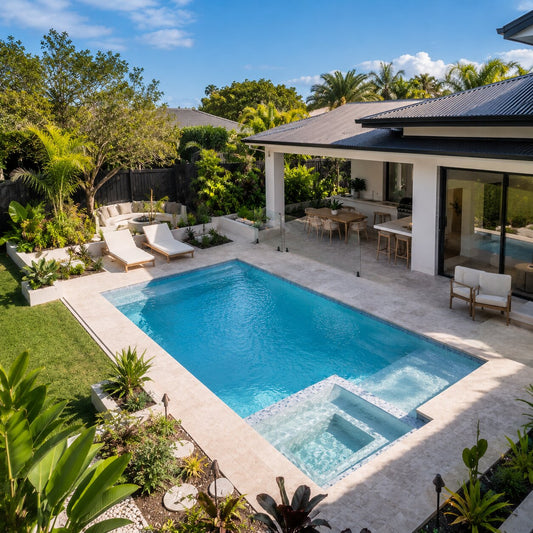
If your build includes an integrated spa, winter is when it shines. The spa is genuinely useful at 36-38°C on a cool Brisbane evening. Running cost for the spa alone (heat pump) is roughly $30-$60/month.
If you've got Wahoo pool and have a winter question, ring the office. If you're considering a build, ask us about the spa option.
— Travis